
What Is HYPE? Hyperliquid Explained
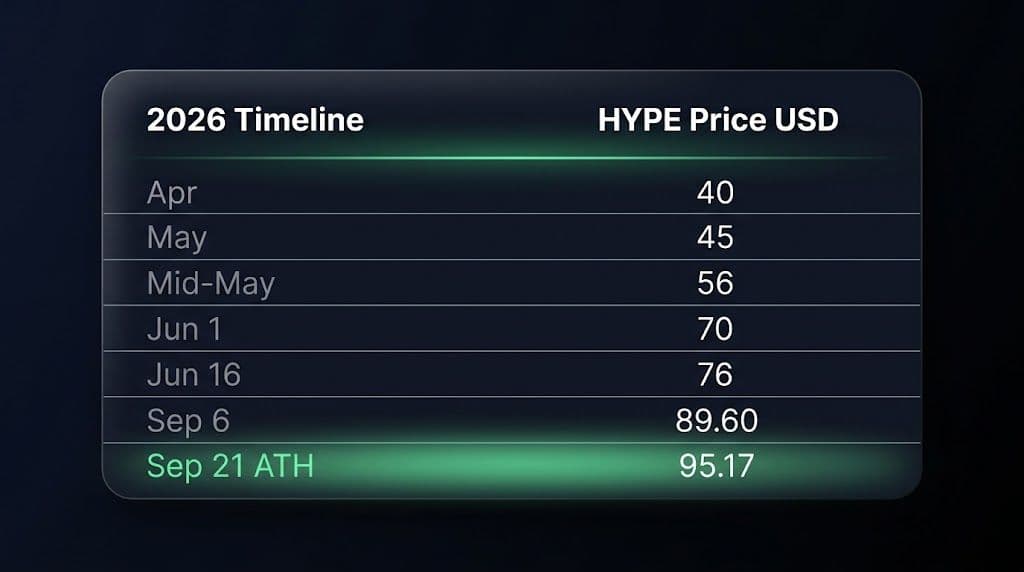
If you're anywhere near crypto Twitter right now, you've seen $HYPE running. September 18, 2026 fresh ATH above $92, up roughly 15% on the week. The usual crowd is calling top, the usual crowd is calling $200. Neither camp is really looking at the fundamentals, and that's the part worth actually breaking down.
HYPE isn't a narrative token. It's one of the few assets in this market where the on-chain numbers back up the price action instead of just vibes and a good Discord. Let's get into the mechanics.
What Hyperliquid Actually Is

At the core, Hyperliquid is a perp DEX decentralized exchange for perpetual futures. Leveraged, no expiry, on-chain settlement. What makes it different from the last cycle's wave of perp DEXs is that it's not sitting on top of Ethereum or Solana dealing with someone else's block times and gas markets. It's a sovereign L1, purpose-built for order matching.
Two core pieces:
- HyperCore: the on-chain CLOB (central limit order book). Sub-second finality, zero gas on order placement, matching engine that actually competes with CEX latency.
- HyperEVM: EVM-compatible execution layer so builders can ship contracts using the same tooling they already know from Ethereum.
Underneath it all is HyperBFT, the consensus layer doing the heavy lifting that lets this thing run at CEX speed without falling back to a trusted sequencer. It's the architectural bet that made Hyperliquid credible with serious traders in the first place self-custody without giving up execution quality.
The Fundamentals Behind the Token
Most L1 and DEX tokens have a governance-token problem: no cash flow, no real claim on protocol economics, value accrual is basically a story you tell yourself. HYPE breaks that pattern in a few specific ways.
Market share. As of March 2026, Hyperliquid held 44% of all decentralized perp volume, up from 36.4% in January, and over 70% of open interest across the category. That's not "leading the pack" that's a moat. Aster and edgeX have both bled share over the same window.

Protocol revenue. Cumulative revenue past $1 billion, annualized run rate pushing $840M, all fee-derived, not emissions-subsidized. That's a real revenue multiple you can actually underwrite, unlike most L1s where "revenue" is a rounding error next to token inflation.
No VC overhang. No private round, no seed allocation, no cliff-and-vest schedule sitting on the chain waiting to unlock and dump on spot. The 2024 TGE distributed supply directly to users via airdrop one of the cleanest fair launches this cycle has seen. If you've been burned by a VC unlock candle before, you understand why this matters structurally, not just narratively.
User growth. MAUs past 270,000, roughly double where they sat at the start of the year. Volume can be wash-traded or farmed for points. Sustained trader growth across multiple quarters is a harder thing to fake.
New credit market. September 18 also marked the launch of manual borrowing HYPE and BTC as collateral, borrow USDC/USDT (65% LTV on HYPE, 50% on BTC). $269M borrowed in the first 24 hours. That's HyperCore extending from pure execution into a lending primitive, which matters for capital efficiency across the whole stack.
The Buyback Engine
This is the mechanism that actually matters for token holders. The Assistance Fund routes roughly 97–99% of protocol fee revenue straight into HYPE buybacks on the open market. It's functionally a systematic share repurchase, priced in real time against fee flow.
With cumulative revenue past $1B and the overwhelming majority of that recycled into buybacks, you're looking at hundreds of millions in tokens already pulled off circulating supply. It's the closest thing crypto has to a DCF-able cash flow story married to a deflationary supply mechanic and it's one of the few tokens where you can actually model this the way you'd model a share buyback program on a public equity.
HIP-3 and the RWA Angle
HIP-3 lets anyone permissionlessly spin up new perp markets on the chain commodities, equities, whatever. Open interest on HIP-3 markets went from ~$260M to ~$790M in a single month earlier this year and hasn't slowed. This is the part of the thesis that gets institutional desks paying attention: Hyperliquid isn't just fighting for perp DEX share anymore, it's building the rails to compete with slivers of CME and Nasdaq's business. That's a much bigger TAM than "biggest DEX."
Where This Can Go Wrong
Supply overhang. Max supply is capped at 1B, circulating isn't fully out yet. Future unlocks are the standing bear case if buyback velocity doesn't keep pace with new supply hitting float, that's downward pressure.
Liquidation risk. Any leveraged perp venue is structurally exposed to cascade liquidations in a sharp downturn. This isn't unique to Hyperliquid, but it's worth sizing into risk management if you're holding size.
Regulatory overhang. The CLARITY Act cleared Senate Banking 15-9 back in May, and has since stalled on a cloture vote that needs 60 to advance it hasn't gotten there as of today. Until there's actual market-structure clarity in the US, perp DEXs operate in a gray zone that could shift under regulatory pressure.
Valuation dispersion. Sell-side and analyst targets range from sub-$50 to $300+. That spread tells you the market hasn't converged on a framework is this a DEX token, an L1 asset, or a fee-generating fintech business? Depending which lens you use, you get wildly different fair value.
Fact
HYPE is one of the rare tokens this cycle where you can actually build a fundamentals-based thesis real revenue, real buybacks, real user growth, a fair launch with no VC overhang. That doesn't make it a free lunch. Dilution, leverage risk, and regulatory uncertainty are all live variables. But it's a genuinely different risk profile than most of what's trading on narrative alone right now.
Not financial advice do your own diligence before sizing a position.