

Why Your Brand Needs to Be Legible to AI Agents in 2026
For the last twenty years, being found online meant being found by Google. You optimised for keywords, backlinks, and page speed, and if you got it right, a human clicked through to your site and decided for themselves whether to trust you.
That's no longer the whole game.
A growing share of people now ask ChatGPT, Perplexity, or Gemini to recommend a business, compare products, or explain a service and get an answer with no click involved. The AI reads the web on the user's behalf, decides which businesses are credible enough to mention, and presents a summary. If your brand isn't structured in a way these systems can parse and trust, you don't get filtered out gently. You simply don't exist in the answer.
This is the shift some are calling AEO Answer Engine Optimisation, or more broadly, AI legibility. Here's what it actually means and what to do about it.
How AI agents decide who to recommend

Search engines used to rank pages. AI agents extract facts. When someone asks Perplexity "which accounting firm in Abuja handles small business tax filing," the model isn't scanning ten blue links it's pulling structured facts about firms from across the web, cross-checking them against each other, and stitching together an answer. That process rewards businesses whose information is unambiguous, consistent, and machine-readable, and it quietly drops businesses whose information is scattered, contradictory, or buried in unstructured prose.
Three things matter most in that process: how well your data is structured, how consistent your identity is across the web, and how much independent evidence backs up your claims.
Structured data: speaking the machine's language
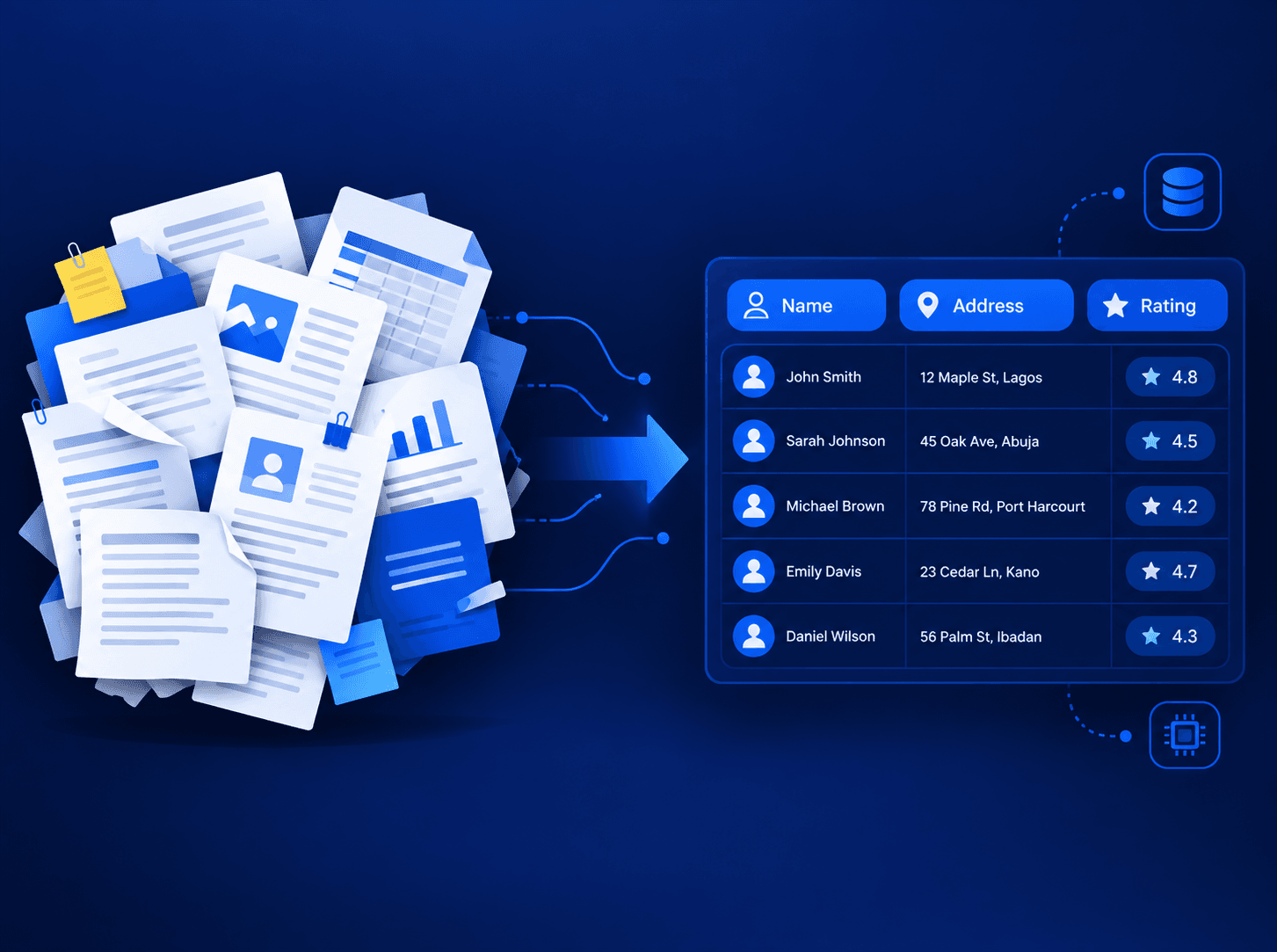
Structured data (schema markup) is code embedded in your website that explicitly labels what things are this is a business, this is its address, this is a review, this is a product with this price. Without it, an AI model has to infer meaning from ordinary text, which is slower and more error-prone. With it, the model gets clean, unambiguous facts it can lift directly.
For a local or service-based business, the schema types worth prioritising are:
- LocalBusiness / Organization name, address, phone, hours, category
- Review / AggregateRating genuine customer feedback, marked up so it's machine-readable
- FAQPage common questions answered in a format models can quote directly
- Product / Service clear descriptions, pricing, and availability where relevant
None of this is exotic. It's a well-documented standard (schema.org), and most website platforms have plugins or simple ways to add it. The businesses skipping it aren't doing so out of strategy they just haven't gotten to it yet, which is exactly the opportunity.
NAP consistency: one identity, everywhere
NAP stands for Name, Address, Phone the basic identity triplet of a business. AI systems (and the search engines feeding them) cross-reference your NAP across your website, Google Business Profile, social media, directories, and any place your business is mentioned. When those details match exactly, it builds confidence that this is one real, verifiable business. When they don't a slightly different business name on Instagram, an old address on a directory listing, a phone number that doesn't match anywhere it introduces doubt, and doubt gets a business quietly excluded rather than flagged for review.
This is a cleanup job most businesses have never done: audit every place your business is listed, and make the name, address, and phone number identical, character for character, everywhere.
Review signals: proof from people, not just from you

Anyone can claim to be reliable on their own homepage. AI models weigh third-party evidence much more heavily genuine reviews on Google, industry directories, or review platforms, especially ones that are recent, detailed, and varied in what they praise. A business with fifty specific, recent reviews reads as more credible to an AI system than one with five generic five-star ratings from three years ago, even if both have the same average score.
Practically, this means actively asking satisfied clients for reviews on the platforms that matter, responding to them (which signals an active, real business), and not treating reviews as a vanity metric they're becoming part of your machine-readable trust profile.
Authoritative content: answering the questions, clearly
The content on your site should be written to directly and clearly answer the questions your customers are actually asking, not to perform search-engine tricks. AI models favour content that states things plainly clear headings, direct answers near the top, specific facts and numbers rather than vague claims because that's what's easiest to extract and quote back to a user with confidence.
This also means demonstrating real expertise: author bios with real credentials, specific case studies instead of generic claims, and content that shows you actually understand the subject rather than content that's been produced to hit a word count.
What to do this quarter
If AI legibility feels like a lot to take on at once, the order of operations that gives the fastest return is:
- Fix NAP consistency across every platform where your business appears.
- Add basic schema markup (Organization, LocalBusiness, and FAQPage at minimum) to your website.
- Start actively collecting and responding to reviews on your most important platforms.
- Rewrite your top few pages so they answer real customer questions directly, with clear structure.
None of these require a large budget or a technical team. They require deciding that being legible to a machine reading on someone's behalf is now as important as being legible to the person themselves because increasingly, the machine is who's doing the recommending.